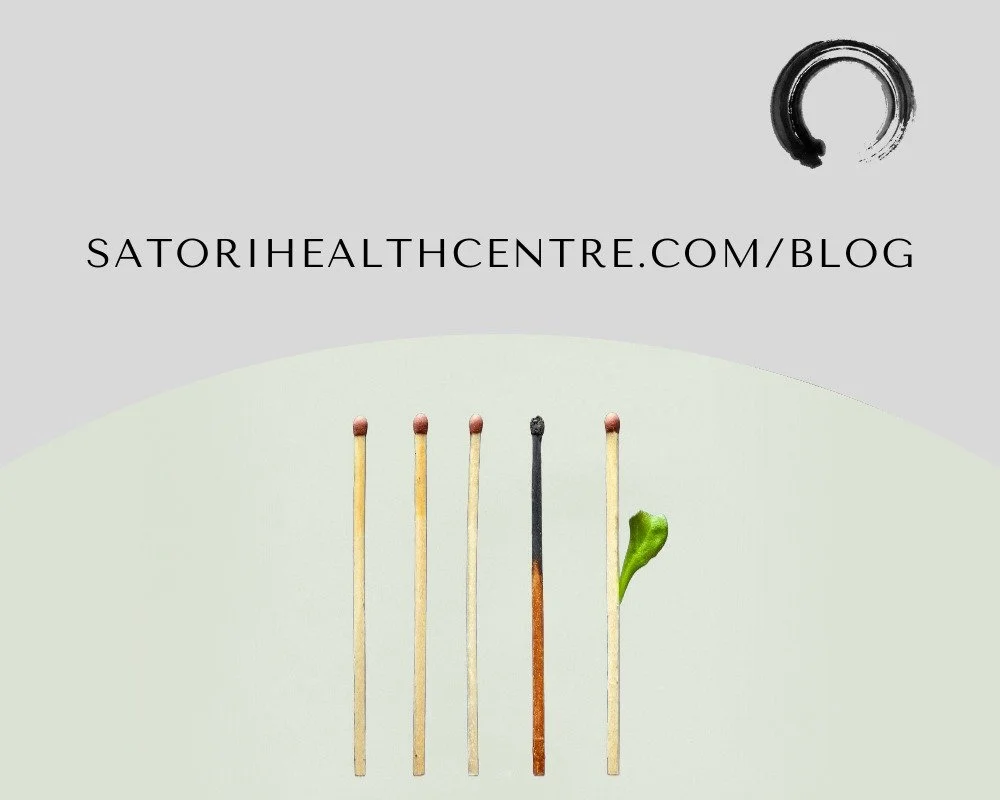
Burnout is not just about personal resilience.
Dr Faye Tsantila, psychologist at Satori Health Centre, Leuven
You go to work. You meet your deadlines. You answer messages, take care of responsibilities, and try to make time for the people who matter to you.
From the outside, everything seems fine. You are managing.
But lately, even the smallest things feel exhausting.
You wake up tired. You struggle to concentrate. Things you once enjoyed begin to feel like another item on your to-do list.
Perhaps you have tried to do something about it. You took a few days off, started exercising, or promised yourself that next week would be different.
And yet, the exhaustion keeps coming back.
At some point, you begin to wonder: Why am I finding everything so difficult when I used to manage so well?
Sometimes, the answer is not simply that you are doing too much. It may also have something to do with how much you expect from yourself, how difficult it feels to slow down, and how long you have been putting your own needs aside.
In short:
- Burnout is not only about workload. How much you expect of yourself, and how hard it feels to slow down, can play a part too.
- Perfectionism, people-pleasing and a mind that never switches off can make rest feel undeserved and keep exhaustion going.
- You don't have to wait for a crisis. Talking to a psychologist can help you understand these patterns and begin to respond to them differently.
When being the reliable one becomes exhausting
Are you the person others turn to when something needs to be done? The one who remembers everything, finds solutions, and rarely complains?
Perhaps you are proud of being independent, responsible, and capable. There is nothing wrong with these qualities.
But sometimes, being the person who can handle everything comes with an invisible expectation: I should always be able to cope.
You might find it difficult to ask for help because you believe you should manage on your own. You might say yes when you want to say no because disappointing someone feels uncomfortable.
Or you might continue pushing yourself even when you are exhausted because stopping feels like failing.
Over time, these patterns become so familiar that you barely notice them.
You simply keep going. Until keeping going starts to feel impossible.
Why rest doesn't always feel restful
Imagine you finally have a free Saturday.
There is nothing urgent to do. No meetings, no deadlines. You have been looking forward to this moment all week.
But instead of feeling relaxed, you feel restless.
You think about the messages you haven't answered, the tasks waiting for Monday, or the things you could be doing instead.
Perhaps you even feel guilty for spending the afternoon doing nothing.
For some people, rest is not simply about having enough free time. It is about feeling psychologically able to take that time.
When your sense of worth becomes closely connected to achievement, productivity, or being useful to others, slowing down can feel surprisingly uncomfortable.
You know you need a break. But emotionally, resting feels undeserved.
And when rest becomes something you have to earn, recovery can become another source of pressure.
The quiet role of perfectionism
Perfectionism does not always mean wanting everything to be flawless.
Sometimes, it looks like constantly worrying that you haven't done enough.
Replaying a conversation because you are concerned you said the wrong thing. Struggling to make decisions because you are afraid of making a mistake. Or finding it difficult to enjoy an achievement because you are already thinking about what comes next.
For some people, the underlying belief is: If I do everything right, I will be okay.
Perhaps being successful helps you feel secure. Being needed helps you feel valued. Avoiding mistakes helps you feel accepted.
These patterns often develop gradually, shaped by our experiences, relationships, and the environments in which we grow up.
They may have helped you achieve important things. But they can also become exhausting when your expectations leave little room for uncertainty, imperfection, or ordinary human limitations.
When your mind never really switches off
You finish work, but your mind continues reviewing the day.
Was your colleague upset with you? Did your manager notice that mistake? Should you have handled that conversation differently?
You anticipate problems that haven't happened yet and prepare responses to conversations you may never have.
Even when everything is going relatively well, you struggle to feel completely at ease.
Worrying can sometimes feel productive. It creates the impression that you are preparing, preventing mistakes, or staying one step ahead.
But constantly trying to anticipate and control what might happen can leave little space for simply being present.
And sometimes, the exhaustion comes not only from everything you are doing, but also from everything you are thinking about.
Why saying no can feel so difficult
We hear about boundaries constantly.
Protect your time. Learn to say no. Put yourself first.
It sounds straightforward.
But what happens when saying no brings up guilt?
What if you worry that someone will be disappointed, angry, or think less of you?
You might agree to something because it feels easier than managing the discomfort of refusing. Or you might repeatedly explain your decisions, hoping the other person will understand.
The difficulty is not necessarily that you don't know how to set boundaries.
Sometimes, you are trying to avoid the feelings that come with setting them.
Understanding these emotional patterns can help you begin responding differently, even when doing so feels uncomfortable.
Understanding your exhaustion means understanding yourself, too
The World Health Organization describes burnout as the result of chronic workplace stress that has not been successfully managed, and working conditions play an important role. But our personal histories, emotional patterns, and beliefs about ourselves can also influence how we experience and respond to pressure.
My background in workplace mental health research, including my PhD in clinical psychology at KU Leuven, has shaped how I understand the relationship between psychological wellbeing and the environments in which we live and work.
In my work as a psychologist at Satori Health Centre, I am interested not only in what someone is experiencing, but also in the patterns surrounding those experiences.
What makes it difficult to slow down? What happens emotionally when you disappoint someone? How do you respond to mistakes? What expectations do you place on yourself?
These questions are not about blaming yourself for your exhaustion. They are about becoming curious about patterns that may have developed over many years, often without you even noticing.
And sometimes, understanding those patterns is the beginning of meaningful change.
You don't have to wait until you can't cope anymore
Perhaps you recognise yourself in some of these experiences.
You are still doing your job, meeting expectations, and taking care of your responsibilities. But you are tired of feeling that everything requires so much effort.
You might even wonder whether your difficulties are serious enough to talk to someone about.
After all, other people seem to have it worse.
But psychological support is not only for moments of crisis.
Sometimes, it begins with a simple question: Why does life feel so difficult when, from the outside, everything seems fine?
You don't need to have an answer before seeking support.
If you would like to reflect on your symptoms, the Burnout Assessment Tool, developed at KU Leuven, is a free, research-based questionnaire available in English, Dutch, French, Greek and other languages. A questionnaire can't give you a diagnosis, but it can be a useful starting point for a conversation with your GP or a psychologist.
Being able to cope does not mean you have to keep coping in the same way.
Ready to explore what's behind your exhaustion?
If any of this resonates with you, I work with people experiencing stress, anxiety, perfectionism, burnout-related difficulties, and the pressure of constantly trying to meet expectations.
A first session is an opportunity to talk about what you have been experiencing, explore what might be contributing to it, and see whether working together feels like a good fit.
I offer sessions in English and Greek, in person at Satori Health Centre, Vaartstraat 68 in Leuven, or online. Sessions are €70 for 50 minutes.
You can book a first session here, or read my profile to get a sense of how I work.
Frequently asked questions
What is burnout?
The World Health Organization describes burnout as the result of chronic workplace stress that has not been successfully managed. It is usually recognised by three things: feeling exhausted or depleted, feeling more distant or cynical about your work, and feeling less effective. Burnout is not classified as a medical condition, but it can affect every part of life.
How is burnout different from stress?
Stress often comes with a sense of urgency: too much to do, and pressure to keep up. Burnout tends to feel more like running on empty, with tiredness that rest doesn't fix, less motivation, and a sense of detachment. Stress that continues for a long time without enough recovery can lead to burnout. If low mood, hopelessness or loss of interest reach beyond work, it is worth speaking with your GP or a psychologist, as these can also be signs of depression.
Can perfectionism lead to burnout?
It can contribute. Perfectionism often means setting very high standards, worrying about mistakes, and finding it hard to rest until everything is done. Over time, this can leave little room for recovery. Understanding where these expectations come from is often part of the work in therapy.
When should I talk to a psychologist about exhaustion?
You don't need to wait until you can't cope. If you have felt tired for weeks despite resting, if things you once enjoyed now feel like effort, or if you keep wondering why life feels so hard when everything seems fine, it can help to talk it through. It is also wise to see your GP to rule out physical causes of fatigue.
Can I see a psychologist for burnout in English in Leuven?
Yes. At Satori Health Centre in Leuven, Dr Faye Tsantila offers sessions in English and Greek, in person or online. Our wider team works in English, Dutch, French and several other languages.
Last updated 1 November 2026